
Do you still look down at the keyboard to find the letters, and wish you could type faster without making twice as many mistakes?
Speed is not a talent. It comes from one habit, not looking at the keys, and a few weeks of short practice. You will probably get slower for the first week or two while your fingers learn new places, but don’t worry, that dip is normal and it passes.
What holds most people back is one of these:
- Looking at the keyboard instead of the screen
- Typing with two or three fingers
- Chasing speed before accuracy
- Hammering backspace after every mistake
- Practising for an hour once instead of a little every day
Below I will show you the nine habits that make the difference, the free sites worth practising on, and what speed is realistic.
So let’s get started.
1) Learn the home row
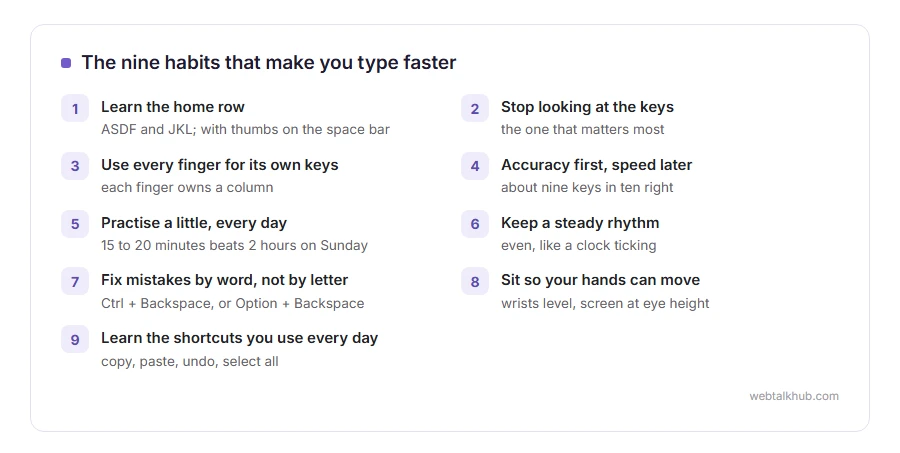
Rest your left fingers on A, S, D and F, and your right fingers on J, K, L and the semicolon. Your thumbs sit on the space bar.
Feel the small bumps on F and J. They are there so your index fingers can find home without looking, and every other key is reached from these eight and then back again.
2) Stop looking at the keys
This is the one that matters most, and the hardest for the first few days. Put a tea towel over your hands if you have to.
Every glance down breaks your rhythm and costs you your place on the screen. Keep in mind that nobody types quickly while looking at the keyboard, however fast their two fingers are.
3) Use every finger for its own keys
Each finger owns a column of keys. The left little finger takes Q, A, Z and the shift key, the index fingers take two columns each, and so on across the board.
Most trainers show this as a coloured keyboard. It feels clumsy at first, because your strongest fingers have been doing all the work for years.
4) Accuracy first, speed later
Type slowly enough to make almost no mistakes. Speed comes by itself once the movements are automatic, and a mistake repeated a hundred times gets learned just as well as the right movement does.
Aim for around nine keys out of ten right or better before you push the pace.
5) Practise a little, every day
Fifteen to twenty minutes a day beats two hours on a Sunday. Your hands learn from repetition spread over days, not from one long session.
If you are a beginner, I recommend keybr.com or TypingClub first, because they teach the keys a few at a time. Monkeytype and typing.com are good once you know where everything is and want to push your speed.
6) Keep a steady rhythm
Try to press the keys at an even pace, like a clock ticking, rather than in bursts. Rushing the easy words and stalling on the hard ones is slower overall than steady typing.
7) Fix mistakes by word, not by letter
Hammering backspace one letter at a time wastes time. Ctrl and Backspace deletes a whole word on Windows, and Option and Backspace does it on a Mac.
8) Sit so your hands can move
Wrists level and floating, not resting on the desk edge, elbows at about a right angle, and the screen at eye height. Tense shoulders make for slow, tired fingers.
9) Learn the shortcuts you use every day
Copy, paste, undo, select all and switching windows each save a trip to the mouse. It is not typing speed exactly, and it is where much of the time at a keyboard really goes.
How fast is fast?
Typing tests count five characters as one word. Most typing test sites put the average adult at somewhere around 40 words a minute, and 60 to 70 is comfortably quick for office work.
Beyond that, speed rarely helps in real work, because you think slower than you type. Our word counter and character counter are handy for checking what you wrote rather than how fast.
When this will not help
A new keyboard does not make you faster by itself. A comfortable one helps you practise for longer, and the speed still comes from practice.
If you have pain in your wrists or fingers, typing more is not the answer. See somebody about it before you put in the hours.
FAQ(Type Faster)
How long does it take to learn touch typing?
Most people know the keys within two to three weeks of daily practice, and get back to their old speed after that. The gains keep coming for months.
Is it worth learning if I already type fast with two fingers?
Usually, yes. Two finger typists hit a ceiling because they have to look down, and touch typing takes that ceiling away.
What is a good typing speed?
Around 40 words a minute is typical, and 60 or more is fast for everyday work.
Do I need a special keyboard?
No. Any keyboard with bumps on F and J works for learning.
Can I learn to type faster on my phone?
Phone typing is a different skill, mostly thumbs and autocorrect. Swipe typing is the quickest route to speed there.
If you have any issues, you can ask me via comment, and I will love to help you out.
