
You have to send an email to somebody who matters, a manager, a client, a teacher or a company you want to work for, and you want it to come across as a professional email rather than a text message with a greeting on top.
The good news is that professional does not mean formal or long. It means the other person can see in five seconds who you are, what you want and by when. Most emails that read badly fail on one of those three, not on the vocabulary.
Here is what a professional email is made of:
- A subject line that says what the email is about
- A greeting that fits how well you know them
- A first line that says why you are writing
- One request, stated plainly
- Short paragraphs
- A sign-off and a proper signature
- A last read before you press send
In this article I will go through each part, give you three short examples you can adapt, and list the small mistakes that quietly undo a polite email.
So let’s get started.
1) The subject line
Write it so the person could act on it without opening the email. “Invoice 2231 due Friday” works. “Quick question” and “Hello” do not, because they tell the reader nothing and look like the start of a sales pitch.
Keep it to around six to eight words, and put the important word first, since phones cut long subject lines off. This will not help if one email is really three topics, because no subject line can cover all of them, so split it.
2) The greeting
Use their name. “Dear Ms Khan” suits a first email to somebody senior or outside your company, “Hi Sara” suits nearly everything else, and if they reply with their first name, use it from then on.
“Dear Sir or Madam” and “To whom it may concern” read as though you did not look for a name. They are only right when there truly is no name to find.
Keep in mind that some countries and industries, law and government among them, still expect “Dear” in every email, so match whatever the other person uses.
3) The first line
Say who you are and why you are writing, in one sentence. “I am the new account manager for your order and I am writing about the delivery date” does more work than two lines of pleasantries.
“I hope this email finds you well” is not wrong, and it is filler. If you use it, keep it to that one line.
4) The request
Ask for one thing, clearly, and say when you need it. “Could you send the signed form by Thursday?” gets answered. “Let me know your thoughts when you get a chance” often does not, because there is nothing specific to do.
It is like leaving a note on somebody’s desk: if they have to guess what you want, the note goes to the bottom of the pile. Two unrelated requests are better sent as two emails, so neither gets lost in a reply.
5) Short paragraphs
Two or three lines each, with a blank line between them. A block of text on a phone screen gets skimmed, and the one sentence that mattered is the one that gets missed.
6) The sign-off and signature
“Kind regards” and “Best regards” are safe everywhere. “Thanks” works when you are asking for something. “Cheers” is fine with people you know and odd with people you do not.
Under it, your full name, your role and a phone number. If your email program has no signature set up, set one up once and it is done forever.
7) The last read
Read it once as the other person. Check the name is spelled right, the attachment is actually attached, and the tone would still sound fine if they were having a bad day.
I suggest reading it aloud before you send, at least for the first few months of writing to people at work. It catches the sentence that sounds sharp on the screen and the one that never finished. If your own voice skips over things, your computer can read the email back to you in another one.
Three examples you can adapt
Asking for something:
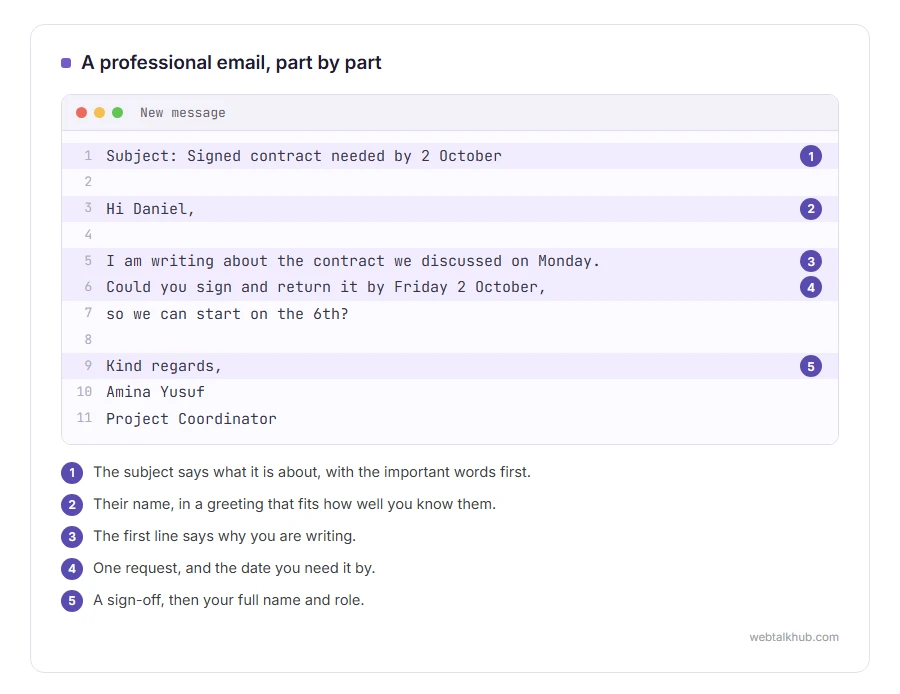
Subject: Signed contract needed by 2 October
Hi Daniel,
I am writing about the contract we discussed on Monday. Could you sign and return it by Friday 2 October, so we can start on the 6th?
It is attached, and page 4 is the only one that needs a signature.
Kind regards,
Amina Yusuf
Project Coordinator
Following up when nobody answered:
Subject: Following up: quote for the website work
Hi Laura,
I sent over the quote for the website work on 12 September and wanted to check it reached you. If anything in it needs changing, I am happy to adjust it.
Best regards,
Amina
Apologising for a delay:
Subject: Report delayed to Tuesday
Hi Mark,
The monthly report will reach you on Tuesday rather than Friday, because the sales figures arrived late. I will send it first thing Tuesday morning.
Sorry for the change of plan.
Kind regards,
Amina
Keep in mind that these are shapes, not scripts. Copied word for word to somebody who knows you well, a template reads stiff, and people notice.
The small mistakes that undo a polite email
Reply All when only one person needed the answer. Check the To and Cc boxes every time, and our guide on how to send an email explains what each of those boxes really does.
Writing in capitals, or with three exclamation marks. Both read as shouting, whatever you meant.
Sending from an address like coolguy99. For anything about work or money, use an address with your real name in it.
Sending while angry. Write it, save it as a draft, and read it again an hour later. If one has already gone that should not have, our page on recalling an email in Outlook explains the narrow cases where that works.
FAQ(Professional Email)
How long should a professional email be?
Short enough to read on a phone without scrolling much. Five to ten lines covers most emails, and anything longer probably wants to be a call or an attachment.
Is “Hi” too casual for a professional email?
Not for most workplaces now. “Dear” is safer for a first email to somebody senior or formal, and “Hi” is fine almost everywhere after that.
How do I end a professional email?
“Kind regards” or “Best regards”, then your full name, role and phone number underneath.
How soon should I follow up if nobody replies?
Two or three working days is reasonable for most requests. Reply to your own email so the history travels with it.
Should I use emojis in a professional email?
Not in a first email. Once the other person uses them, one here and there is fine.
If you have any issues, you can ask me via comment, and I will love to help you out.
If writing emails takes you ages
Part of that is the words and part of it is the keyboard.
- how to type faster, the habit that matters most and the free trainers worth fifteen minutes a day.
