
Have you hit a page that says 410 gone, and wondered how that is different from the ordinary not found error everybody knows?
Don’t worry, there is nothing wrong with your browser or your computer. A 410 is one of the few error codes that is deliberate: the site is telling you this page existed, it was removed on purpose, and it is not coming back. A 404 says we cannot find it, which leaves the door open. A 410 closes the door and locks it.
That difference matters more to site owners than to visitors, so this page is split:
- If you landed on one while browsing, the short section below is all there is
- If you run a site, the rest explains when a 410 is the right choice, how to set one, and what it does to your search results
So let’s get started.
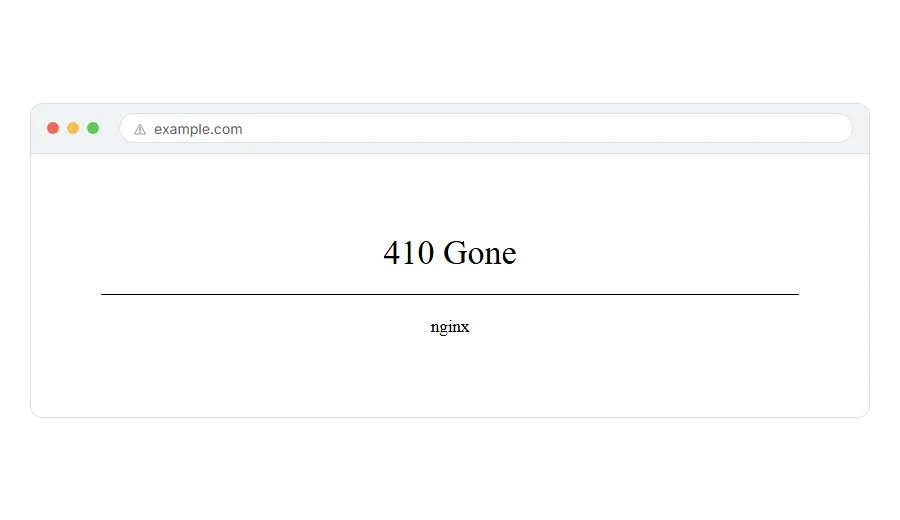
If you are just a visitor
There is very little to do, which is the honest answer.
Check the address for a typo, then search the site for what you wanted, because the page may have moved rather than been deleted and the owner simply did not redirect it. The internet archive at web.archive.org often still has a copy if you need the old content.
Reloading will not help, and neither will clearing your cache. The server is not failing, it is answering your question with a no.
Where it actually breaks
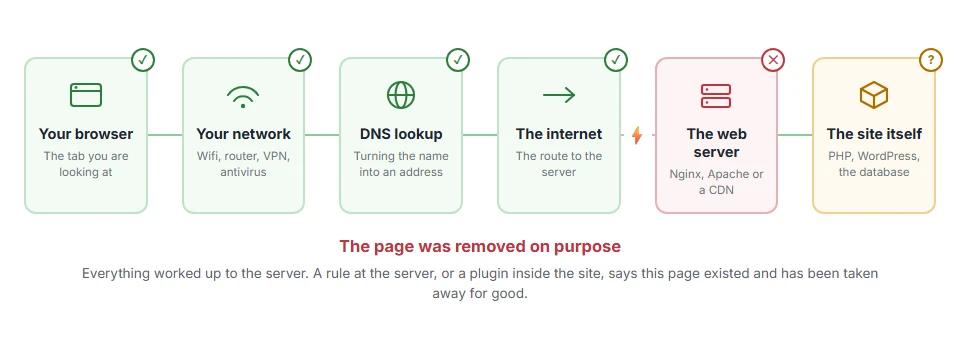
Every page you open makes the same journey. Knowing which step this error stops at tells you which half of the list below is worth your time, because the green steps are already proven to be working.
1) When a 410 is better than a 404
Both codes tell a search engine the page is not there, and Google treats them almost the same.
With either code, Google drops the page from its index and checks the address less and less often over time. A 410 is the firmer signal, because it says the page was removed deliberately, so it may drop out a day or two sooner. That is about the whole difference.
Use a 410 when you have permanently deleted something and there is no replacement: an expired job advert, a product you will never sell again, an old campaign page, a member’s profile that was removed on request.
It is not for a page that moved. If a page has a new home, a 301 redirect is the right answer and a 410 throws away everything that page had earned.
2) How to return a 410 in WordPress
The simplest way is a redirect plugin. In Redirection, add the source URL, set the action to Error (404) and pick 410 Gone as the code. There is no target to fill in. Rank Math and Yoast Premium both have the same option in their redirects screen.
If you prefer code, a snippet in your theme’s functions.php can send the header for a list of addresses.
Watch what you delete, because a plugin sending 410s for a pattern rather than a single address can take out pages you meant to keep. This will not help at all if your caching layer is still serving the old page, so clear the cache and check again before you believe it.
3) How to return a 410 on Apache or Nginx
On Apache, in .htaccess: Redirect gone /old-page-address. There is no target address, which is the point.
On Nginx, inside the server block: location = /old-page-address { return 410; }.
Keep a copy of the file before you edit it. A wrong line in either of these takes the whole site down rather than one page, and you want the old version to hand.
4) Check what the server is really sending
The page can look right and still be sending a 200, which tells search engines everything is fine.
Open your browser’s developer tools with F12, go to Network, load the address and read the status in the first row. Or use an online HTTP header checker and paste the address in.
A pretty “sorry, this page is gone” design that returns 200 is the worst of both worlds: the reader sees an ending and the search engine sees a live page. That is the single most common mistake here.
5) What happens to your search results
Google says it treats a 410 and a 404 the same way, and both get dropped from the index. A 410 may go a day or two sooner, though nobody can promise an exact number and anybody who does is guessing.
Links pointing at a 410 page pass nothing on, exactly like a 404. If the page had good links, a 301 to the closest living page keeps that value and a 410 throws it away. Either way, find the broken links on your own pages that still point at the old address, and change them.
So the honest rule: 410 when the thing is truly gone and nothing replaces it, 301 when anything sensible replaces it, and 404 when you genuinely do not know.
FAQ(410 Gone Error)
Is a 410 error bad for SEO?
Not in itself. It is a clean way of saying a page has gone, and search engines handle it well. Using it on a page that should have been redirected is what costs you.
What is the difference between 404 and 410?
404 means not found, which might be temporary. 410 means removed on purpose and not coming back.
Can I change a 410 back later?
Yes. Delete the 410 rule first, in your redirect plugin, .htaccess or Nginx config, then publish something at that address and it becomes a normal page.
Why does my page show 410 when I did not set one?
A security plugin, a redirect plugin or your host may be sending it. Check your redirect rules first, then ask the host.
Should I use 410 for spam or hacked pages?
Yes, that is a good use. Pages added by a hack should be removed and then answered with a 410, so they drop out of search quickly. If you want them gone from Google faster, our page on removing URLs from Google search covers the removal tool.
If you have any issues, you can ask me via comment, and I will love to help you out.
