
If you have been told your site needs an SSL certificate, then read somewhere that SSL is dead and everything is TLS now, you are right to wonder which one you are actually meant to have.
The short version of SSL vs TLS is that they are the same idea from two different decades. SSL was the first version, every version of it was broken and retired, and TLS is what replaced it. Every padlock you see in a browser today is TLS, even when the company selling the certificate still calls it SSL.
Knowing the difference matters in a few situations:
- Buying a certificate, where the word SSL is only a label
- Setting up a server, where the old versions must be switched off
- Reading an error message that names a protocol version
- Answering a security questionnaire that asks which versions you allow
In this article you will learn how the versions follow each other, what actually changed, why the name SSL refuses to die, and how to see which version a site is using.
So let’s get started.
How SSL became TLS
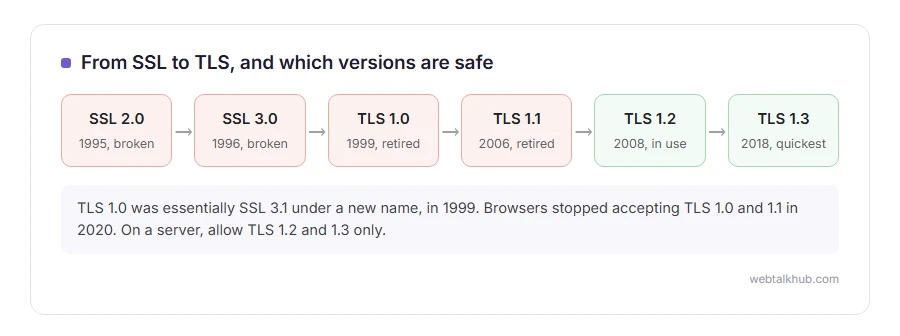
Netscape built SSL in the mid 1990s so that credit card numbers could be sent to a website without anybody in between reading them. SSL 2.0 came out in 1995 and SSL 3.0 in 1996.
In 1999 the standard was handed to the internet’s standards body and renamed TLS 1.0. It was essentially SSL 3.1 with a new name, which is why the two words have been used interchangeably ever since.
Then came TLS 1.1 in 2006, TLS 1.2 in 2008 and TLS 1.3 in 2018. Think of it as a car model that was renamed at its third version and kept improving under the new name.
Which versions are safe today
SSL 2.0 and SSL 3.0 are broken. SSL 3.0 fell to an attack called POODLE in 2014 and was formally retired the following year.
TLS 1.0 and TLS 1.1 are retired too. The big browsers stopped accepting them in 2020, and the standards body made it official in 2021.
TLS 1.2 and TLS 1.3 are what the web runs on. TLS 1.3 is the newer and quicker one: the connection is set up in one round trip instead of two, and the old weak options have been removed entirely rather than just discouraged.
So what is an SSL certificate?
A certificate proves a site is who it says it is, and it does not care which protocol version uses it. The same certificate works with TLS 1.2 and TLS 1.3.
The name SSL certificate stuck because it was the name people learned first, the same way people still “dial” a number on a phone with no dial. When you buy one, TLS certificate and SSL certificate mean exactly the same product.
How to see which version a site uses
In Chrome, press F12 to open the developer tools, open the Security tab and reload the page. The connection line names the version, for example TLS 1.3.
For a full picture of your own server, the free SSL Labs test at ssllabs.com checks every version and setting it allows and grades the result.
If you run a server
I recommend allowing TLS 1.2 and TLS 1.3 only, and switching off everything older. Most hosting control panels and every current web server make that a single setting.
Keep in mind that turning off the old versions locks out very old devices, such as phones from around 2013 and older industrial or payment equipment. For an ordinary website that is almost nobody, and for a payment terminal it can be everybody, so check before you change it on anything unusual.
Errors that mention SSL or TLS
When a browser and a server cannot agree on a version, you get errors such as ERR_SSL_VERSION_OR_CIPHER_MISMATCH or ERR_SSL_PROTOCOL_ERROR. A failed handshake has its own page, and a problem with the certificate itself usually shows as your connection is not private.
Behind Cloudflare, the same failures come out as error 525 and error 526.
FAQ(SSL vs TLS)
Is TLS better than SSL?
Yes. Every SSL version has known weaknesses, and TLS 1.2 and 1.3 fixed them.
Do I need a different certificate for TLS?
No. The certificate you have works with every current TLS version.
Is HTTPS SSL or TLS?
HTTPS is ordinary web traffic sent inside a TLS connection. When HTTPS was new that connection was SSL, and today it is always TLS.
Can I still use SSL 3.0?
No current browser will connect with it. A server that only offers SSL 3.0 is unreachable for almost everybody.
Is TLS 1.2 still safe?
Yes, when it is set up with modern options. TLS 1.3 removes the need to get those options right, which is its main advantage.
If you have any issues, you can ask me via comment, and I will love to help you out.
What all this protects
TLS is the lock. HTTPS is the web’s everyday traffic sent through it.
- What HTTPS is, what the padlock really promises, what it does not, and how to get it free on your own site.
